
A Parent’s Guide to CBE — What It Means for Your Child at Monark
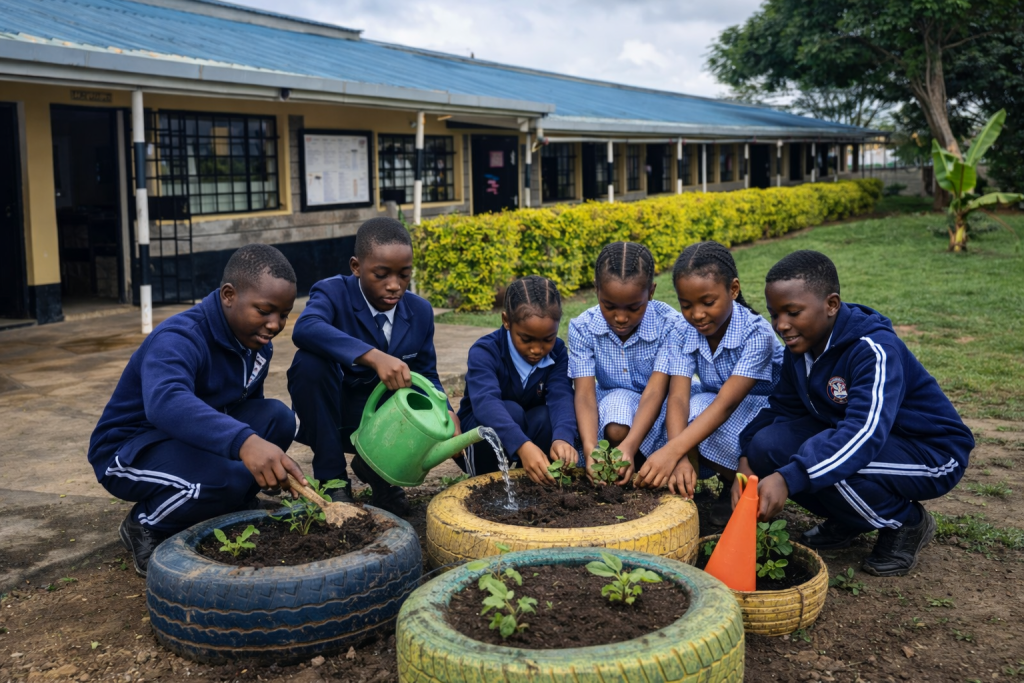
When Kenya announced the full rollout of the Competency-Based Education (CBE) framework, many parents found themselves with more questions than answers. What does this mean for my child’s future? How is it different from the system I went through? Will my child be able to cope? These are entirely reasonable concerns — and this guide is designed to answer them, plainly and practically, from a school that has been implementing CBE from the ground up.
What Is CBE and Why Did Kenya Adopt It?
Competency-Based Education is a curriculum framework that measures what a learner can do with their knowledge, rather than simply what they can recall under exam pressure. The old 8-4-4 system rewarded memorisation and performance in a small number of high-stakes examinations. CBE shifts the focus to skills, competencies, and continuous assessment over time.
Kenya adopted this framework after research and consultation revealed that many graduates — despite passing examinations — were leaving school without the practical skills needed for work, entrepreneurship, or further study. CBE was designed to close that gap by developing learners who can communicate, collaborate, think critically, and adapt to a changing world.
How the New System Is Structured
Under CBE, the education ladder in Kenya looks like this:
- Early Years (Pre-Primary 1 & 2) — play-based learning that builds language, numeracy, and social foundations
- Lower Primary (Grades 1–3) — literacy and numeracy consolidation alongside values and life skills
- Upper Primary (Grades 4–6) — broadening subject range and introduction of Agriculture, Social Studies, and Creative Arts as distinct strands
- Junior Secondary (Grades 7–9) — more specialist subjects, pre-vocational pathways, and preparation for Senior Secondary
At Monark School, we offer education from PP1 through Grade 9 — covering the full pre-secondary journey under one roof, with a consistent philosophy running through every level.
The 7 Core Competencies CBE Targets
Rather than measuring a child purely by grades, CBE tracks the development of seven core competencies that are considered essential for life and work. These are:
- Communication and Collaboration — expressing ideas clearly and working constructively with others
- Critical Thinking and Problem Solving — analysing situations and finding reasoned solutions
- Creativity and Imagination — generating new ideas and applying them in novel ways
- Citizenship — understanding rights, responsibilities, and respect for community
- Digital Literacy — using technology safely and productively
- Learning to Learn — building self-management and study habits
- Self-Efficacy — developing confidence and a growth mindset
These competencies are not assessed in a single sitting. They are observed, built, and recorded across the entire school year through classwork, projects, group activities, and teacher observations.
How Assessment Works Under CBE
This is where many parents feel the most uncertainty. If there is no single end-of-year exam, how do you know how your child is doing?
CBE uses Continuous Assessment Tests (CATs) throughout the term to track academic progress in each subject. Alongside these, teachers maintain Learner Profiles that document a child’s competency development, attitude, and holistic growth. At the end of each level, there are Summative Assessments — structured evaluations that confirm a learner’s readiness to move to the next stage.
For parents used to a single percentage on a report card, this system takes some adjustment. But the benefit is significant: you receive a richer, more accurate picture of what your child can actually do, not just how they performed on a particular morning.
How Monark School Implements CBE Every Day
At Monark School, CBE is not a theoretical framework on a noticeboard — it shapes every lesson, every assessment, and every interaction between teacher and learner. Our classrooms are designed to facilitate discussion, group work, and hands-on learning. Project work is a regular feature of each term, and teachers are trained to facilitate learning rather than simply deliver content.
Our 1:15 teacher-to-learner ratio means that every child is seen and known. Teachers monitor individual competency development closely, and any gaps are identified early. Parents receive regular updates, and we hold termly meetings to discuss not just grades but the full learner profile — who your child is becoming, not just what score they achieved.
What Parents Can Do to Support CBE Learning at Home
CBE works best when home and school are aligned. Here are practical ways you can support the CBE journey from your side:
- Ask your child to teach you something — if they can explain what they learned, they have truly understood it
- Encourage questions, not just answers — CBE values curiosity as much as correct responses
- Engage with the Learner Profile — when your child brings home their profile, go through it together and celebrate growth, not just grades
- Read together — literacy underpins every competency, and daily reading at home makes a measurable difference at every level
- Stay in contact with the class teacher — do not wait for parent-teacher day; reach out whenever you have a question or concern
Final Thoughts
CBE is not a perfect system — no curriculum ever is. But it is a genuine attempt to prepare Kenyan children for the world they will actually inherit: one that rewards critical thinking, adaptability, and the ability to work with others. At Monark School, we believe in this vision, and we work every day to make it a reality for each of our learners.
If you have questions about how CBE works at Monark, or if you would like to understand what your child’s current level means in practice, we would love to speak with you. Contact us to arrange a conversation with one of our teachers, or visit our admissions page to learn how to join the Monark community.