
School Life at Monark: A Day in the Life
Choosing the right school for your child means understanding what their day-to-day experience will look like. At Monark School in Athi River, every morning begins with purpose — and every afternoon ends with growth. Here is an honest, detailed look at what a typical school day feels like for our learners, from the youngest in Pre-Primary all the way through to Junior Secondary.
Morning: Setting the Tone for the Day
The school day at Monark begins at 7:30 a.m. Learners arrive at school and are welcomed by their class teachers, who are already present and ready. This early contact between teacher and learner is intentional — our staff use arrival time to check in with their pupils, notice who seems unsettled, and build the kind of daily familiarity that makes learning feel safe.
Morning assembly runs from 7:45 to 8:00 a.m. and sets a positive tone for the day. Learners participate in a short devotion, school announcements, and a motivational thought shared by a teacher or a senior learner. It is a moment that builds community and reminds every child that they belong to something larger than their individual classroom.
Lessons: A CBC Approach to Learning
Under the Competency-Based Curriculum (CBC), lessons at Monark are structured around what learners can do, not just what they can recite. A typical morning block includes two to three subjects taught in 40-minute sessions. Teachers use a mix of direct instruction, group activities, project work, and practical demonstrations to keep learners engaged.
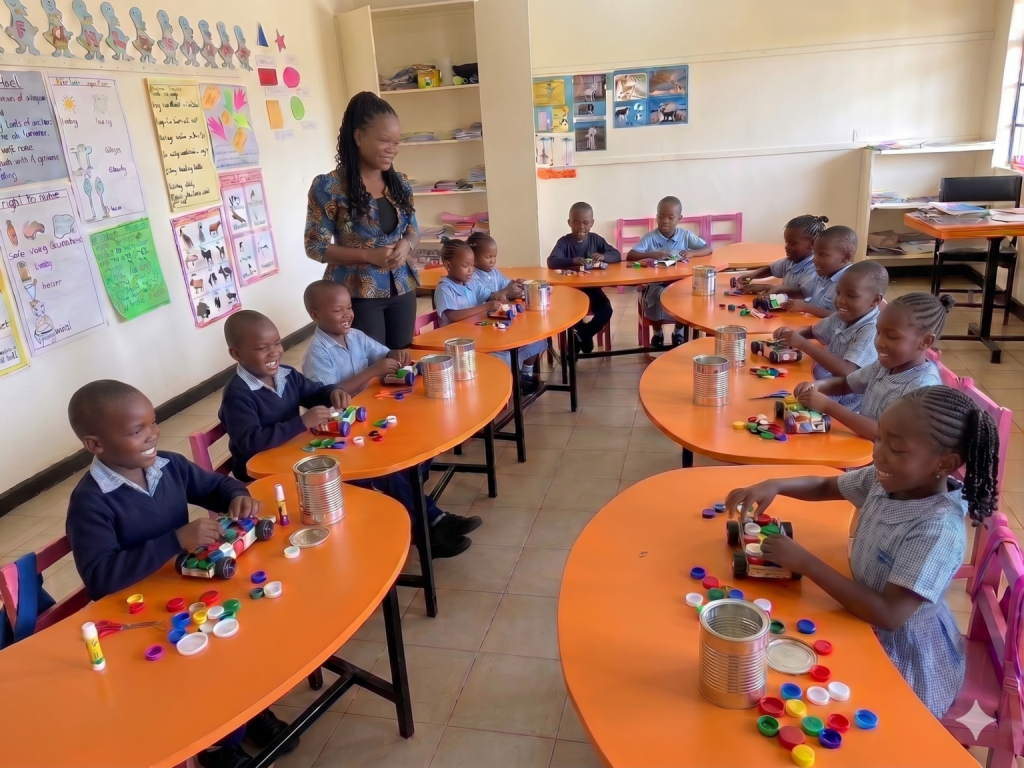
In the lower primary classes, you might walk past a classroom and find learners working in small groups on a creative activity, or listening to a story before writing their own version. In the upper primary, you might see a science lesson where learners record their own observations rather than simply copying notes from a board. At Junior Secondary level, the lessons grow more rigorous — with pre-vocational tracks, integrated sciences, and social studies — but the spirit of active learning remains the same.
Our teacher-to-learner ratio of 1:15 means that no child gets lost in a crowd. Teachers know their pupils by name, by temperament, and by learning style. When a child is struggling, their teacher notices — often before the child says a word.
Break Time and Outdoor Learning
Learning does not stop when the bell rings. The short break at 10:00 a.m. and the lunch break at 12:30 p.m. give learners time to play, interact, and recharge. The school grounds include open spaces where children can run, play structured games, or simply talk with friends.
We believe that play is not a reward for completing work — it is part of the work itself. Social interaction during break time builds communication skills, conflict resolution abilities, and emotional resilience. Our teachers supervise play areas while giving learners the space to navigate friendships and challenges independently.
For boarding learners, lunchtime is a communal occasion. Meals are prepared on-site with balanced nutrition in mind, and learners eat together in a social environment that reinforces the boarding community’s sense of family.
Afternoon Lessons and Co-Curricular Activities
Afternoon lessons run from 2:00 to 4:00 p.m. and often include subjects that benefit from a calmer, more focused atmosphere — reading, written work, or creative arts. For learners in Grades 7 to 9, afternoon sessions may include subject-specific deep-dives that prepare them for the ongoing Summative Assessments that CBC requires at each stage.
On selected afternoons, learners participate in co-curricular activities including:
- Music, dance, and drama
- Sports — football, volleyball, athletics, and skipping
- Environmental club and school gardening
- Debate and public speaking
- Art and craft workshops
These activities are not optional extras — they are part of how CBC measures a child’s development. The curriculum recognises that a well-rounded learner is a stronger learner, and our timetable reflects that belief.
Evening Prep for Boarding Learners
For our boarding learners, the day extends into a structured evening routine. After supper, prep time runs from 7:00 to 9:00 p.m., supervised by a member of staff. Learners use this time to review classwork, complete assignments, and read ahead. The supervised environment reduces distractions and builds independent study habits that will serve them for life.
Lights out is at 9:30 p.m., ensuring that every boarder gets adequate sleep — something that research consistently links to better concentration and memory retention the following day.
How Monark School Approaches Pastoral Care
A busy school day can be overwhelming for some children. At Monark, every learner is assigned a class teacher who acts as their first point of contact for any concern — academic or personal. Our staff are trained to notice changes in behaviour, mood, or performance, and to act on those changes quickly and compassionately.
Parents receive regular feedback through end-of-term reports, parent-teacher meetings, and informal updates when teachers feel a conversation is needed. We do not wait for a problem to become serious before reaching out. Open communication between home and school is something we take seriously at every level.
What Parents Can Do to Support the School Day
A positive school experience is built in partnership with parents. Here are a few ways you can reinforce what your child experiences at Monark from home:
- Ask specific questions — instead of “How was school?”, try “What did you learn in science today?” or “Who did you sit with at lunch?”
- Review their books regularly — CBC portfolios and learner profiles come home periodically; take time to look through them together
- Maintain a consistent bedtime — a rested child is a focused learner
- Encourage reading at home — even 20 minutes of independent reading each evening makes a measurable difference
Final Thoughts
Every day at Monark School is designed to leave a learner feeling capable, connected, and curious. From the warmth of morning assembly to the focus of evening prep, every hour has a purpose. We are proud to offer an environment where children are known, challenged, and celebrated — not just on exam day, but every single day.
If you would like to experience this environment for yourself, we welcome school visits. Come and spend a morning with us and see what a day in the life at Monark School really looks like. Contact us to arrange your visit or start the admissions process today.